Art
The Invisible Skull
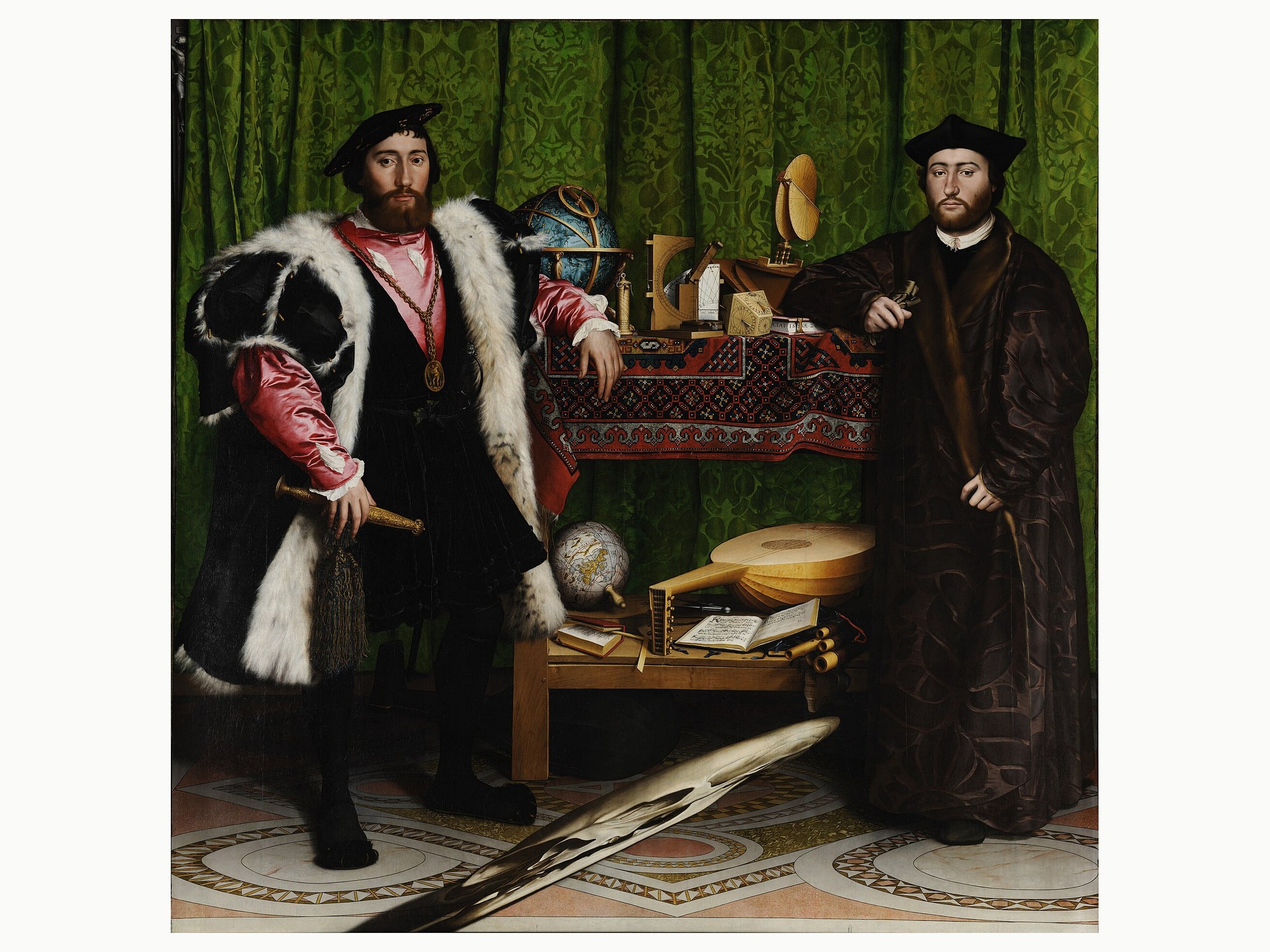
In The Ambassadors by Hans Holbein, a strange elongated object floats in the painting's foreground. Seen head-on, it appears incomprehensible. But from a very precise angle, the shape suddenly transforms into a perfectly visible human skull. This hidden image functions as a brutal intrusion of death into a scene saturated with knowledge, luxury and scientific instruments.
Painted in 1533 by Hans Holbein the Younger, The Ambassadors brings together two men surrounded by learned objects — globes, astronomical dials, measuring instruments, books, precious fabrics — that seem to celebrate all Renaissance erudition. Only one thing jars: in the foreground, an oblong and deformed shape bars the composition without one being able at first to identify it.
This stain obeys anamorphosis, an optical process that only delivers its motif under a very precise viewing angle. The spectator must move to the side for a skull to finally appear, present from the beginning but invisible as long as one looks at the canvas head-on. Death thus stands in the painting as a concealed vanitas, which recalls the fragility of all learned or political prestige at the very moment it displays itself.
Holbein makes vision itself his subject, since seeing correctly supposes placing oneself in the right place and no viewpoint gives access both to the instruments and to the skull. This ambiguity responds to an era passionate about optics, geometry and learned illusions, and transforms the diplomatic portrait into a visual machine where knowledge, power and mortality cohabit according to irreconcilable angles.
Even more discreet, a crucifix slips behind the curtain, at the top left of the canvas. Unlike the skull, it requires no displacement: one need only look for it. Holbein thus juxtaposes two truths that diplomatic pomp would like to keep at bay — the mortality that anamorphosis reveals, and a religious presence almost entirely covered, as if salvation itself occupied only a corner of the painting.