Art
The Tiny Mirror
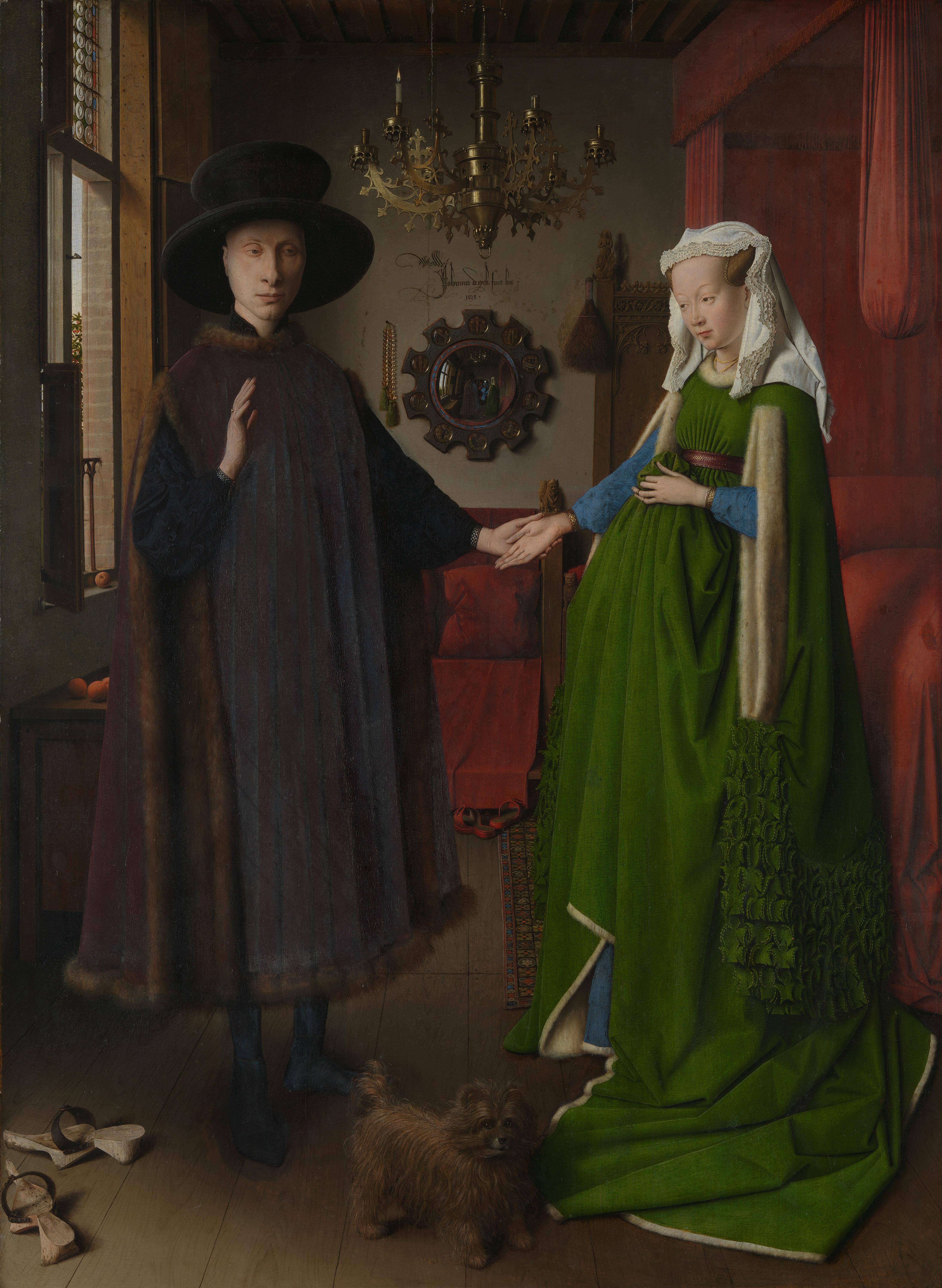
In Jan van Eyck's Arnolfini Portrait, a small convex mirror hanging at the back of the room contains an entire second scene. One can make out the two figures seen from behind, but also two additional visitors entering the painting's space. This minuscule surface suddenly transforms the painting into an extremely complex optical construction.
Jan van Eyck completed the Arnolfini Portrait in 1434 in a vein of Flemish naturalism where each material—fur, stained glass, wood—is rendered with almost tactile exactness. The painting's densest enigma concentrates in the tiny convex mirror at the back, whose spherical curvature reflects a lateral scene invisible from the front: the main figures seen from behind, accompanied by two additional silhouettes who have entered the room. One of them is often identified, without definitive consensus, with the painter himself, which has long fueled debates on his exact status in the composition.
Above the mirror, the Latin inscription "Johannes de eyck fuit hic" ("Jan van Eyck was here") is not merely an artist's signature: several historians see it as the equivalent of visual attestation, in the lineage of contracts or notarial acts that Northern painting sometimes produced. The circular frame completes this device with ten grisaille medallions illustrating the Passion of Christ, painted at so reduced a scale that their reading requires almost physical proximity—the same logic of acuity as the rest of the painting.
Medieval opticians already knew the magnifying properties of convex mirrors; van Eyck mobilizes them to extend pictorial space without leaving the frame. The gaze then circulates between the frontal scene, the inverted reflection, and the implicit presence of the observer, in a spatial construction that art history regularly brings close to mise en abyme. The mirror does not decorate the interior: it reconfigures the relationship between painting, witness, and spectator.