History
Greek fire
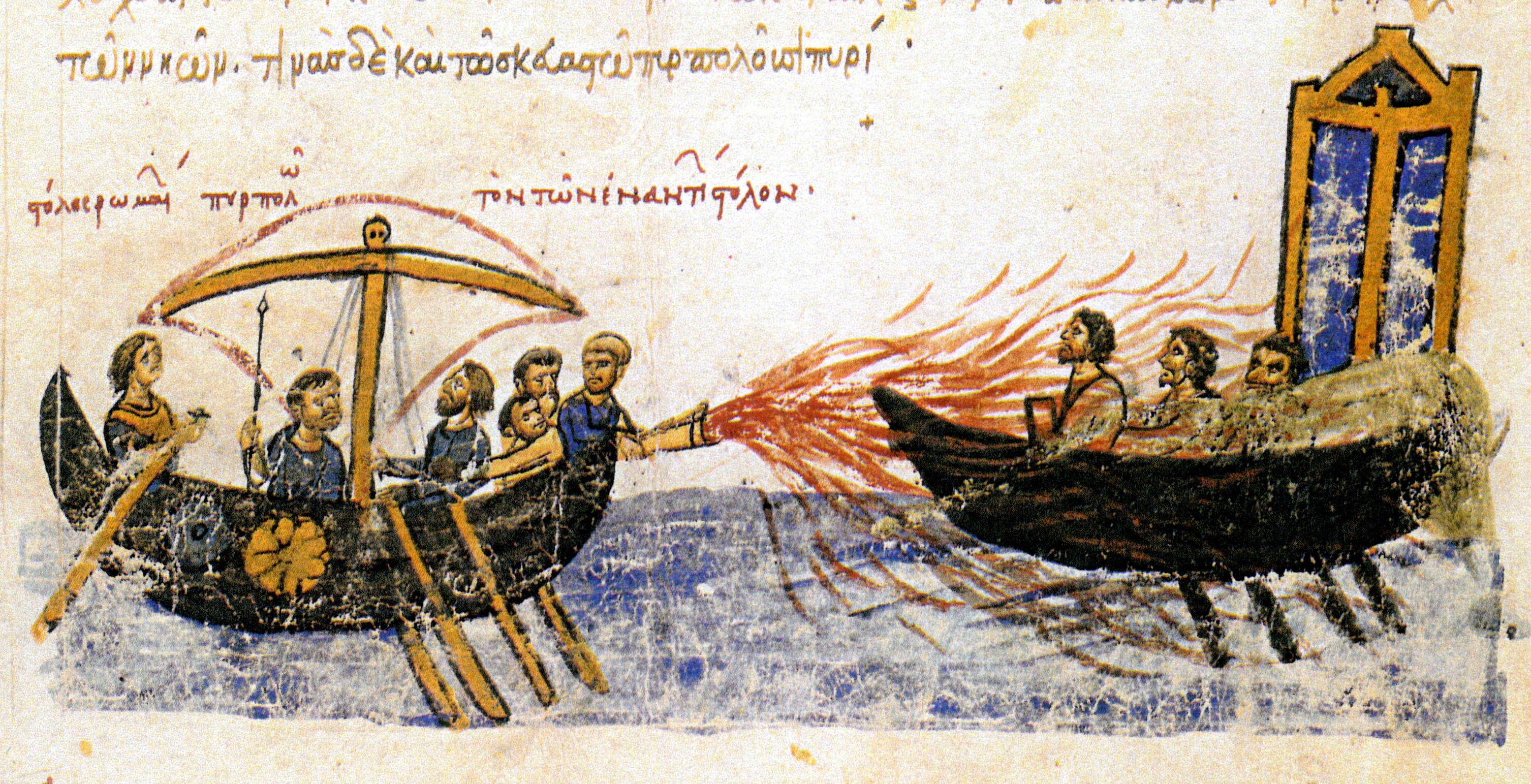
For centuries the Byzantine Empire possessed an incendiary weapon whose exact composition remains unknown. “Greek fire” was sprayed from siphons mounted on ships and kept burning even on water. Its use proved decisive in several sieges of Constantinople and long sustained Byzantine naval superiority.
Greek fire probably appeared in the seventh century as Arab armies expanded rapidly around the eastern Mediterranean. Byzantine sources often credit its invention to an engineer named Kallinikos, a refugee from Syria.
The weapon was used mainly in naval combat. Devices called siphons projected a flammable liquid that clung to surfaces and continued to burn on water. Medieval chroniclers describe especially powerful psychological effects: noisy flames, dense smoke, and the apparent impossibility of extinguishing the substance by usual means.
The exact formula stayed secret because the Byzantine Empire tightly guarded the manufacturing process. Historians today suspect a mix based on petroleum derivatives, resins, sulfur, and quicklime, but no modern reconstruction reliably reproduces the properties described in the texts.
Greek fire played a major strategic role during the Arab sieges of Constantinople in the seventh and eighth centuries. By destroying several enemy fleets, it directly helped the Byzantine Empire survive an extremely critical period. Mastery of the technique quickly became a symbol of imperial power itself—some sources almost present it as a sacred secret passed only to the sovereign.