Culture
Vesalius's Bodies
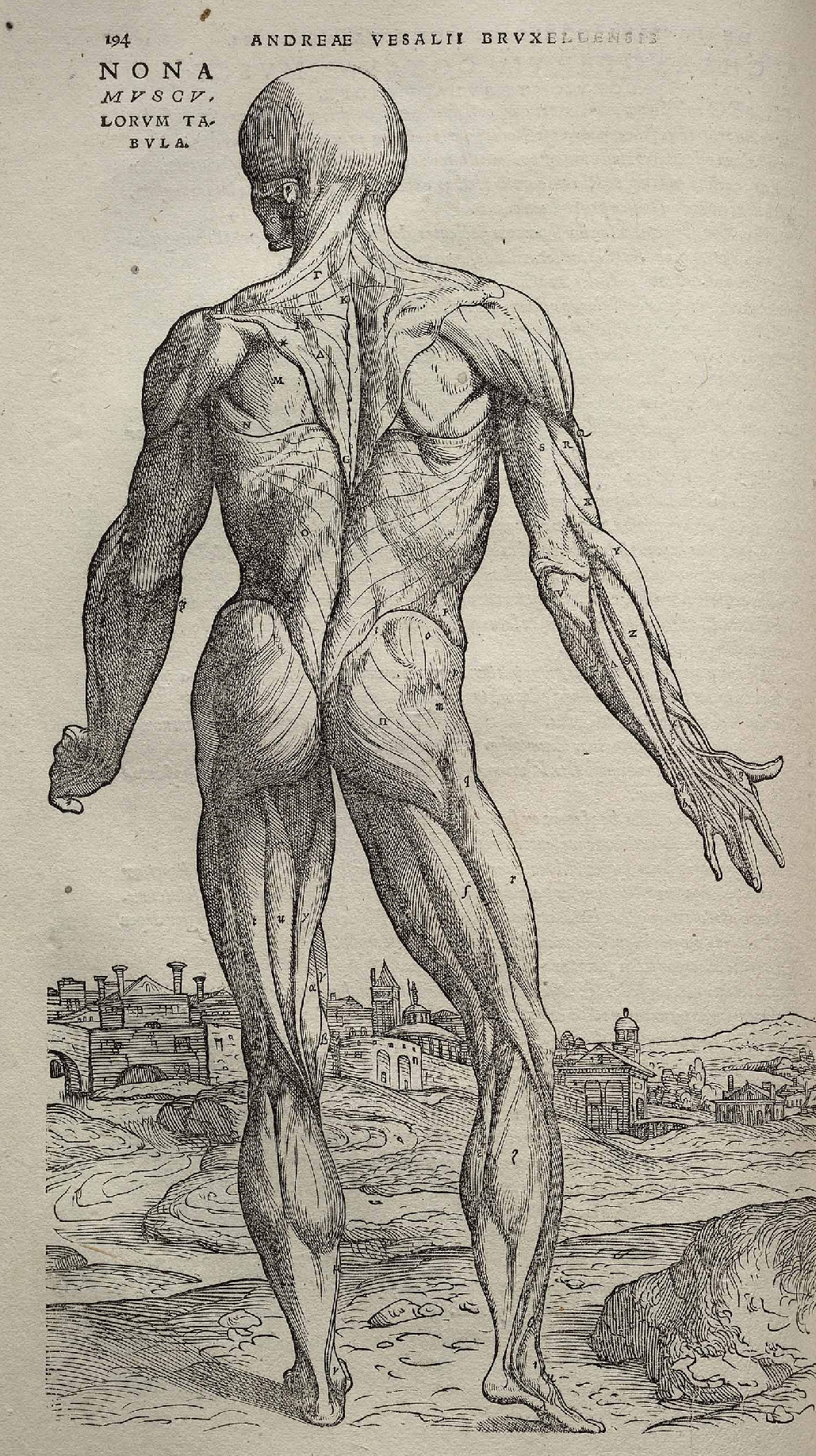
In 1543, Andreas Vesalius publishes a book that overturns European anatomy. His plates do not merely show organs: they stage dissected cadavers like standing characters, almost alive. Behind their graphic beauty, these images mark a major scientific rupture: the human body is no longer only described by the authority of ancient texts, it is observed, opened, corrected, and redrawn.
De humani corporis fabrica appears in Basel in 1543, the same year Copernicus publishes his treatise on celestial revolutions. Vesalius's book is not only a medical manual: it is a visual event, whose large engraved plates show dissected bodies standing in landscapes, inclined, sometimes strangely melancholic.
This staging fascinates as much as it disturbs, because it goes against an anatomy still inherited from Galen, many of whose descriptions came from dissected animals rather than human bodies. Trained in Padua, Vesalius makes direct observation his method and corrects, through human dissection, errors transmitted for centuries. The images are at the heart of this revolution: they fix a knowledge difficult to transmit by speech, making muscles, vessels, and bones readable in a graphic architecture of new precision.
The enterprise also raises a cultural question, since it makes the cadaver an object of public knowledge. Dissected bodies were often those of executed convicts, closely linking justice, medicine, and anatomical spectacle.
The Fabrica thus inaugurates an unprecedented relationship between science and image, where drawing no longer merely illustrates a text: it becomes proof, method, almost an instrument of intellectual dissection.