Literature
The Impossible Encyclopedia
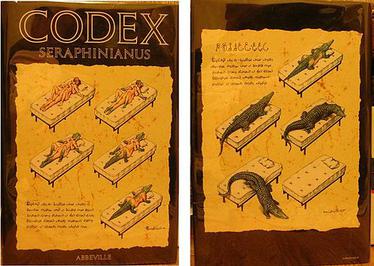
The Codex Seraphinianus resembles an encyclopedia from an unknown civilization. Written in an invented language and filled with absurd biological illustrations, the book describes a world where fish become tools, plants transform into furniture and bodies follow impossible anatomical logics. Everything seems coherent, but nothing can truly be understood.
The Codex Seraphinianus was created in the late 1970s by Italian artist Luigi Serafini. Presented as an illustrated encyclopedia, the book adopts all the codes of classic scientific works: organized chapters, detailed plates, index and regular writing system.
But no element is truly readable. The alphabet used has never been deciphered because it corresponds to no known language. Serafini himself explained that the text should produce in adults the sensation of a child looking at a book they don't yet know how to read. The illustrations reinforce this strangeness. The book shows a pseudo-biology where objects and organisms seem to merge according to unknown internal rules.
The Codex fascinates because it perfectly imitates the visual authority of encyclopedic knowledge while completely removing access to meaning. Several readers describe an experience close to dreaming: everything seems locally logical but impossible to stabilize intellectually.
The work also questions the confidence given to forms of printed knowledge. A dense, classified and annotated page immediately appears serious even when its content becomes totally absurd. The Codex Seraphinianus thus functions as an erudite parody of the modern encyclopedia but also as a psychological experiment on our need to understand visual systems.