Culture
Adelson's Checkerboard
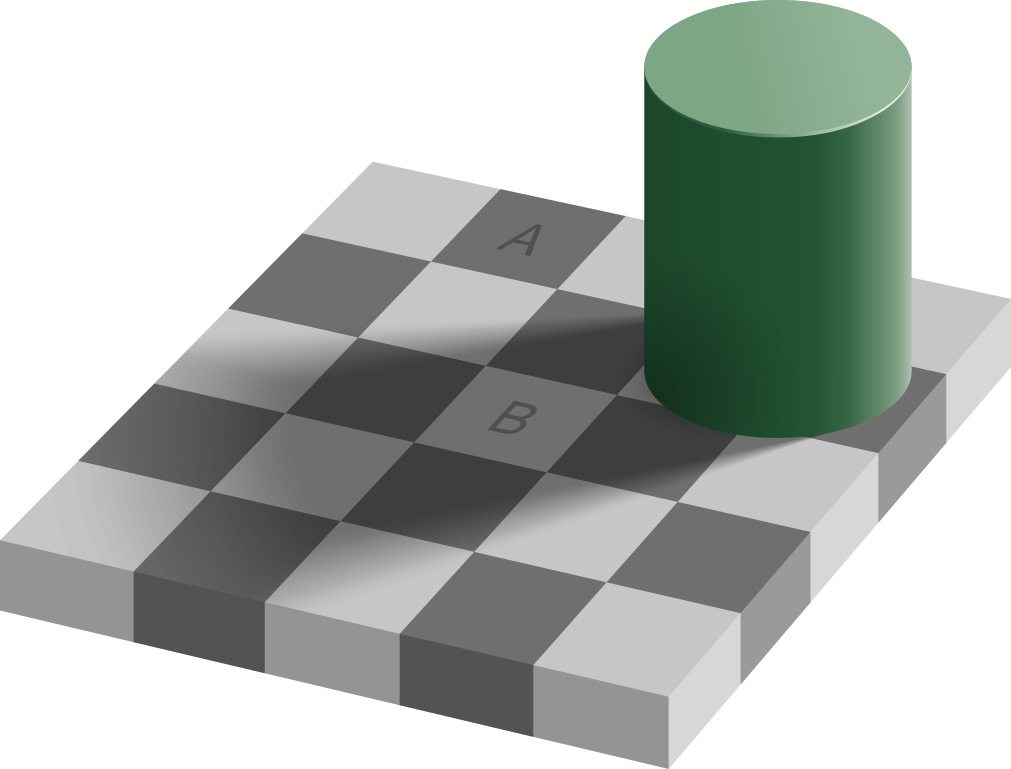
In Adelson's checkerboard illusion, two squares appear radically different colors when they have exactly the same gray value. The effect is so convincing that even after digital verification, the brain often continues to perceive an obvious difference. This experience has become a classic example of how the visual system actively reconstructs luminous reality.
The illusion was published in 1995 by researcher Edward Adelson as part of work on visual perception and shadow interpretation. The image depicts a cylinder casting a shadow on a checkerboard. Two squares identified as A and B seem immediately different: one appears dark, the other light.
Yet when you objectively measure the image's pixels, both surfaces have exactly the same luminance. The perceived gap comes from contextual processing performed by the brain. The visual system doesn't simply seek to record raw light intensities; it constantly attempts to estimate objects' real properties despite lighting variations.
In this image, the brain automatically interprets the area in shadow as artificially darkened. It therefore unconsciously "corrects" square B's supposed brightness to maintain material coherence of the checkerboard. This perceptual compensation produces the illusion.
Adelson's checkerboard has become a major case in visual neuroscience because it shows that human perception functions as probabilistic inference rather than simple photographic capture of the external world. Seeing consists less of recording data than producing a coherent hypothesis about the physical causes of light received by the retina.