Art
The Impossible Sky
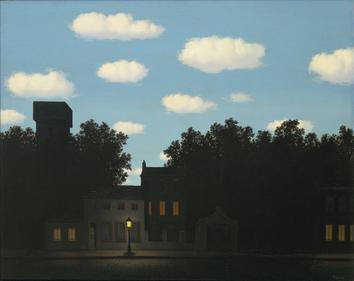
In The Empire of Light, Magritte shows a street plunged in night under a perfectly blue daytime sky. The painting seems calm and realistic at first glance, but this luminous contradiction quickly produces a deeply unstable sensation. Nothing extraordinary happens, yet reality suddenly seems physically incoherent.
Between the late 1940s and the 1950s, René Magritte paints several versions of The Empire of Light around a single gesture: placing a night landscape under a midday sky, in a continuity of perfect verisimilitude. The idea seems almost childish, and that's precisely what makes it troubling—nothing is distorted, everything is in its place, and yet the scene refuses to hold together.
Before the painting, the gaze seeks to reconcile the two lightings without ever succeeding, unable to decide what time it is. Magritte stands apart from the spectacular surrealism of melting clocks and hybrid creatures: his street, trees, and lamppost remain of absolute banality, and it's from this intact normality, barely fissured, that the unease comes.
The painter repeated that he wanted to represent ideas rather than dreams, and the work functions as a thought experiment: a limpid image, immediately readable, but impossible to resolve. By letting day and night cohabit without mixing, he makes perceptible what we ordinarily forget—how much our reading of the world rests on invisible coherences that a single flaw, slipped into an ordinary setting, suffices to make waver.