Culture
Buildings Without Landmarks
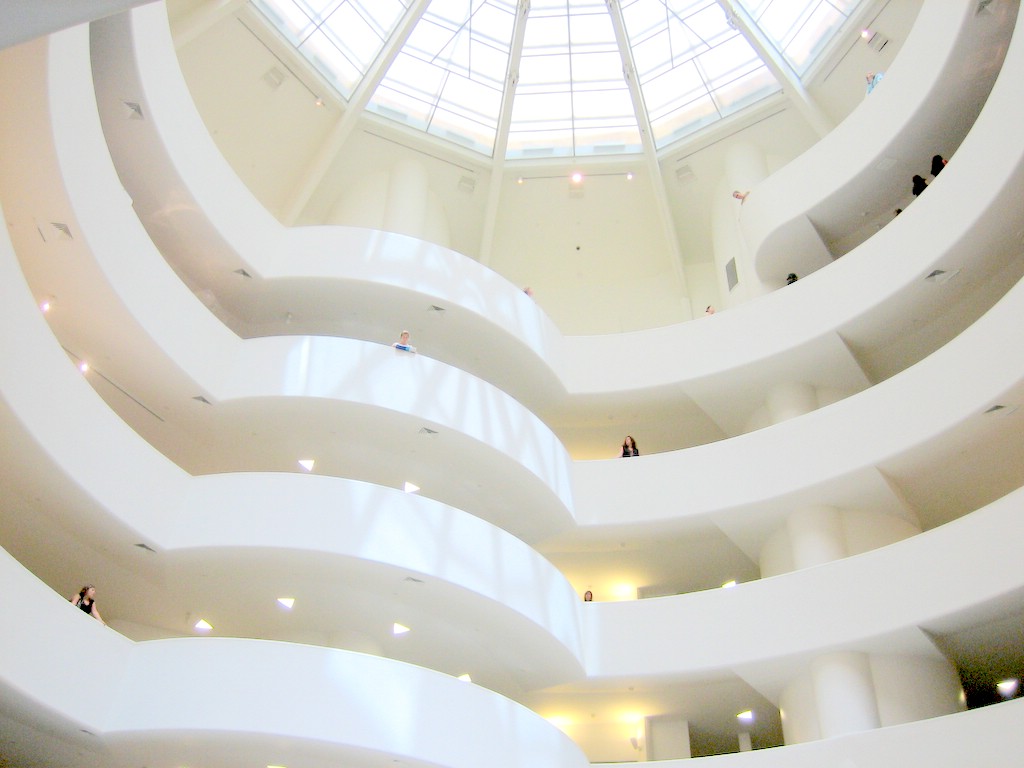
At the Guggenheim in New York, Frank Lloyd Wright replaces the succession of rooms with a single helical ramp. The visitor goes up by elevator then descends in a spiral: an imposed path, without bifurcation, where the orthogonal landmarks of the traditional museum disappear. Designed from 1943 to its opening in 1959, the building takes the form of an inverted ziggurat; Wright wants a continuous and descending path, opposite to the labyrinth of independent galleries.
The spiral deliberately disorients. The permanent slope and curved walls, slightly inclined outward, disturb perception: paintings can be neither plumb nor perfectly aligned there. Before the opening, twenty-one artists sign a protest letter against an architecture that competes with works rather than serving them.
The stake goes beyond aesthetics. Wright makes circulation itself the principal experience: the museum is no longer a neutral container — the "white cube" — but a prescribed promenade, frontal rupture with free paths. Understanding the Guggenheim is seeing how a building can impose a spatial narration as strong as the exhibitions it houses.