History
The Lisbon Earthquake
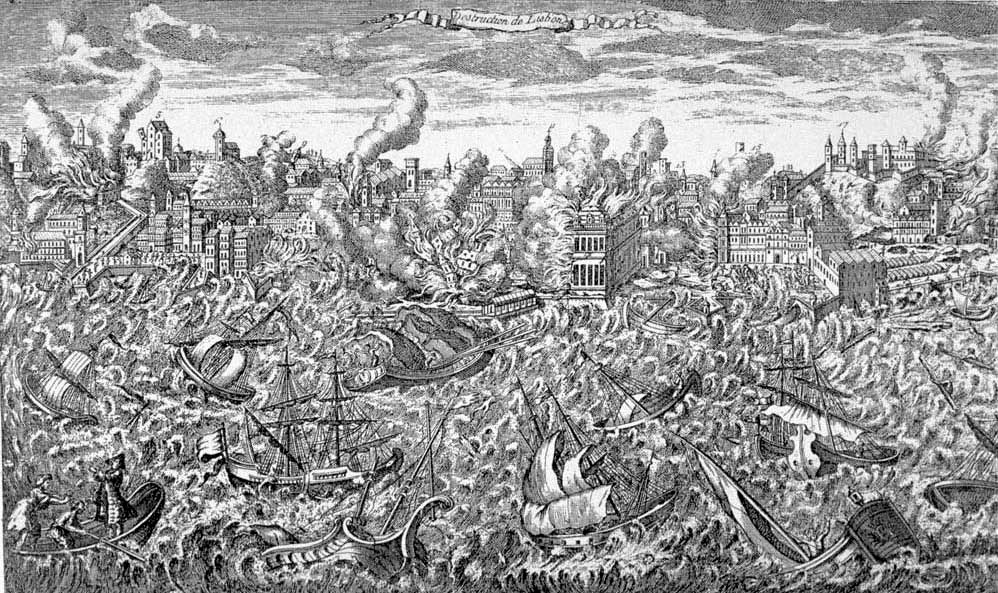
On November 1, 1755, a violent earthquake strikes Lisbon as the population attends All Saints' Day celebrations. Earthquakes, fires, and tsunami destroy a large part of the city in a few hours. The catastrophe quickly exceeds the Portuguese framework: it also disrupts European Enlightenment philosophy and lastingly transforms the scientific study of earthquakes.
On the morning of November 1, 1755, several major shocks strike Lisbon, then one of Europe's most important commercial capitals. A large part of the population is in churches for religious All Saints' Day celebrations when buildings begin to collapse.
Destruction doesn't come solely from the initial earthquake. Massive fires break out rapidly in densely built neighborhoods while a tsunami then strikes the port and coastal areas. Several testimonies describe inhabitants fleeing toward the quays before being carried away by waves.
The catastrophe provokes a major intellectual crisis in Enlightenment Europe. How to reconcile such a deadly disaster with the idea of a rational or providential world? Voltaire uses the earthquake in several texts to criticize philosophical optimism according to which everything necessarily exists for the best.
On the political and scientific level, the Portuguese government's reaction also marks an important step. The Marquis of Pombal organizes systematic inquiries into the earthquake's effects throughout the country. Questionnaires sent to parishes collect data on shock duration, building behavior, and variations in sea level. These observations constitute one of the first modern attempts at empirical study of a major seismic event at national scale.