Art
Botticelli's Primavera
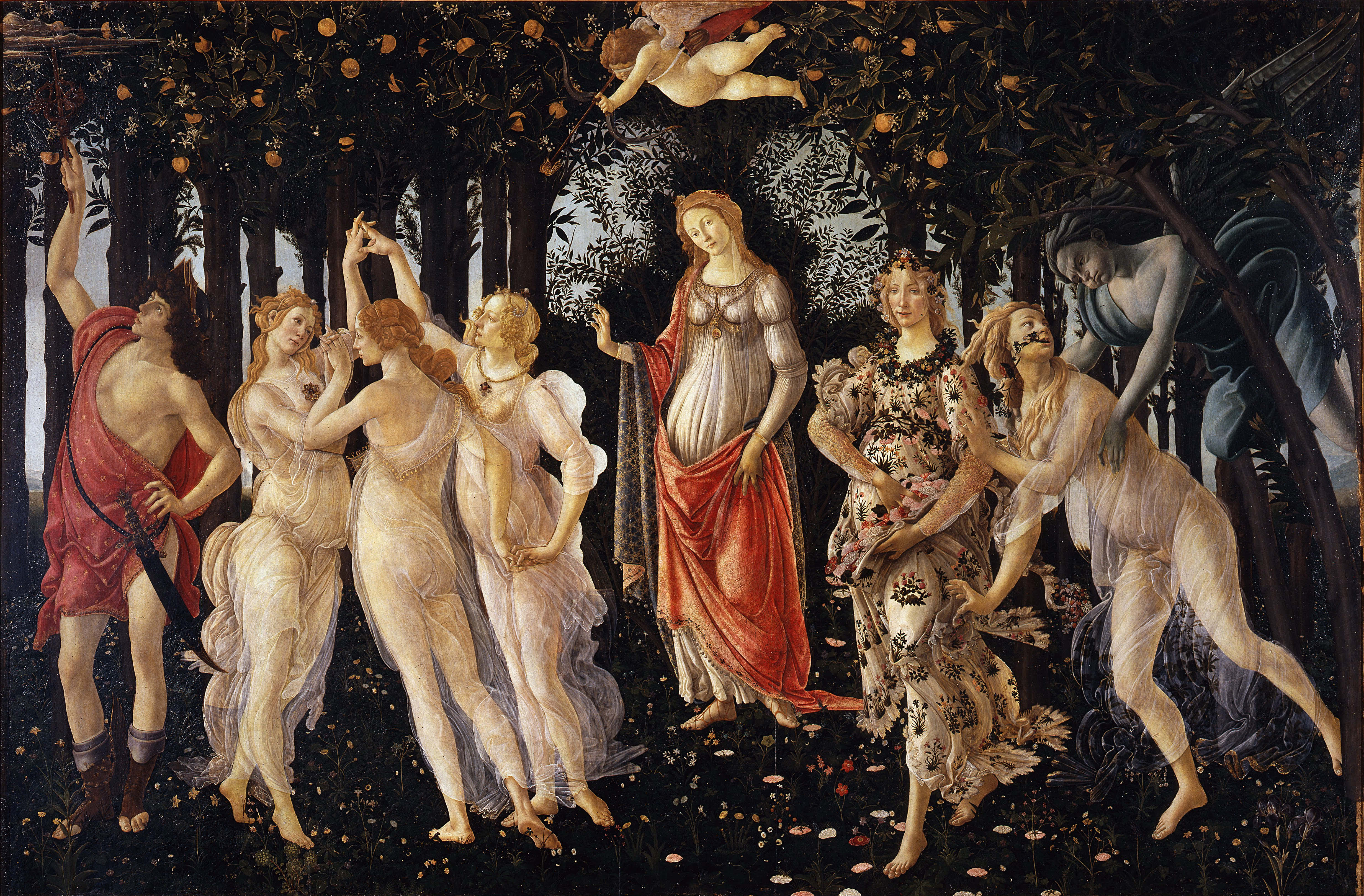
Primavera, painted around 1480 for the Florentine court, aligns more than five hundred identifiable flowers, nine mythological figures, and no unified perspective in the strict sense. Botticelli composes a spring renewal allegory where Mercury, the Three Graces, Venus, Flora, and Zephyr coexist in a suspended garden outside time. The work doesn't illustrate a single narrative: it superimposes several registers—poetic, philosophical, political—specific to Medicean humanism. Each character seems frozen in a silent dance.
The painting is generally read as a celebration of Lorenzo di Pierfrancesco de' Medici's marriage to Semiramide Appiani, but interpretations have varied for centuries. At center, Venus raises her hand in welcome or blessing; above her, Cupid aims at a Grace. At far right, Zephyr pursues the nymph Chloris, whom we see already transforming into Flora, goddess of spring wearing a flowered cloak.
Botanical precision is remarkable: modern botanists have counted nearly one hundred eighty distinct plant species in the foreground meadow. Yet this naturalistic minuteness serves a dreamlike scene, with no coherent cast shadow or classical spatial depth. Botticelli privileges line and silhouette, a Gothic heritage integrated into the Renaissance.
Primavera and The Birth of Venus probably share the same commission and intellectual circle around Marsilio Ficino. Both canvases embody a Florence that converted pagan mythology into educated language for a princely elite.