Architecture
Bramante's Tempietto
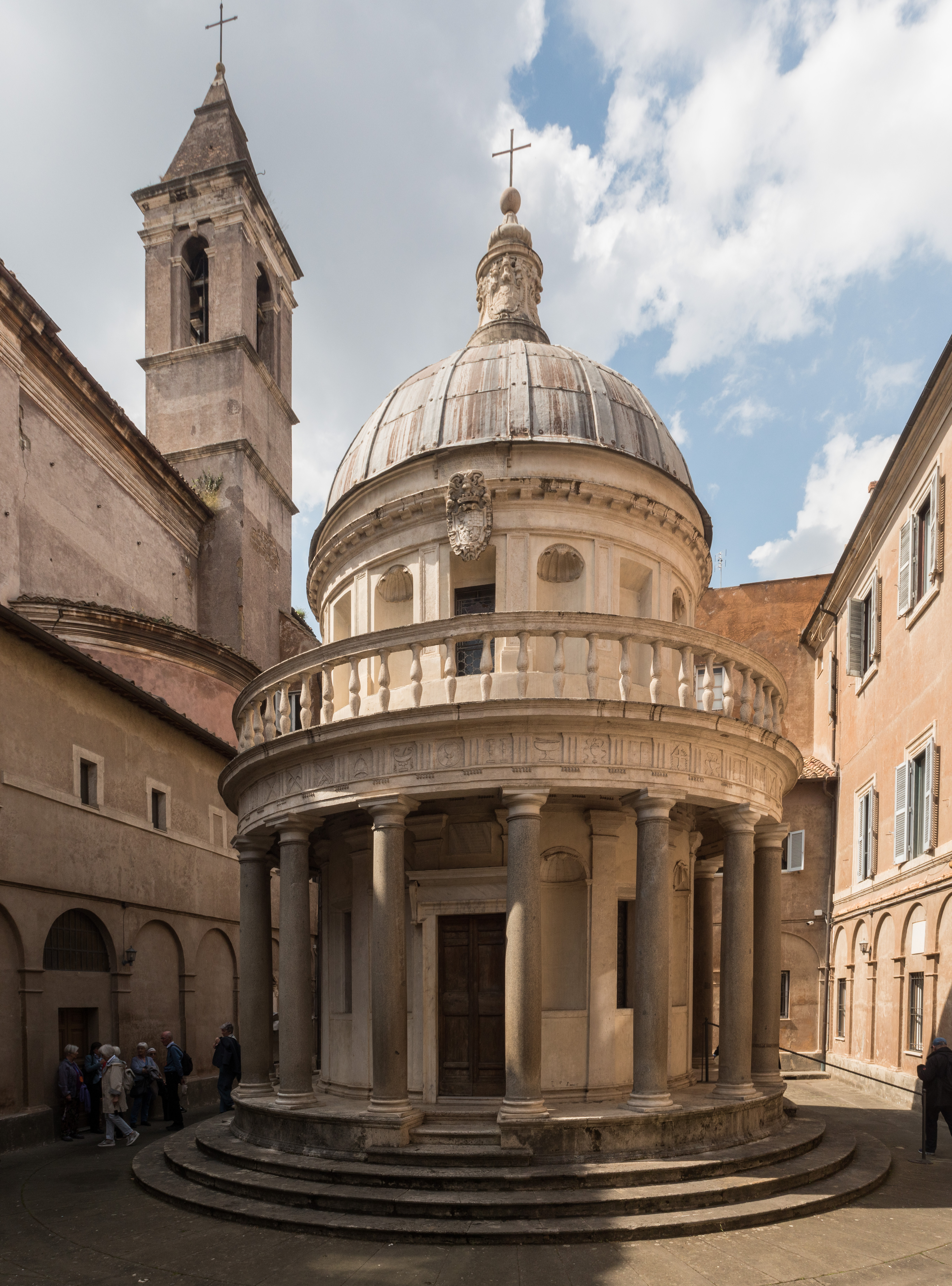
Erected in 1502 in the courtyard of San Pietro in Montorio in Rome, Bramante's Tempietto is a small circular temple that condenses an entire theory of antique architecture. Commissioned by Ferdinand and Isabella of Spain, it marks the spot where Saint Peter was crucified, according to tradition. Columns in Doric order, cylindrical drum, hemispherical dome: Bramante translates Roman ruins into Christian language. The edifice fits in a garden but changes the way Europe imagines central churches.
Bramante, recently arrived in Rome, measures the Pantheon and the Theater of Marcellus; the Tempietto is a miniature synthesis of them. The perfect circle symbolizes the universality of the Church as much as the geometric perfection dear to humanists. Each column is spaced with mathematical regularity; the crypt beneath the temple houses a small commemorative altar. Erected in 1502 in the courtyard of San Pietro in Montorio in Rome, Bramante's Tempietto is a small circular temple that condenses an entire theory of antique architecture.
The building is too small to accommodate an assembly: it's a memorial monument, almost an architectural sculpture. Yet its influence far exceeds its size: Bramante's later projects for Saint Peter's take up the planimetric centrality tested here. Commissioned by Ferdinand and Isabella of Spain, it marks the spot where Saint Peter was crucified, according to tradition.
Perched on the Janiculum, facing the city, the Tempietto offers one of the clearest views of the relationship between Renaissance and Antiquity. It shows that an architectural idea can fit in a few square meters yet still remodel an entire century of construction. Columns in Doric order, cylindrical drum, hemispherical dome: Bramante translates Roman ruins into Christian language.