Art
The Romantic Back
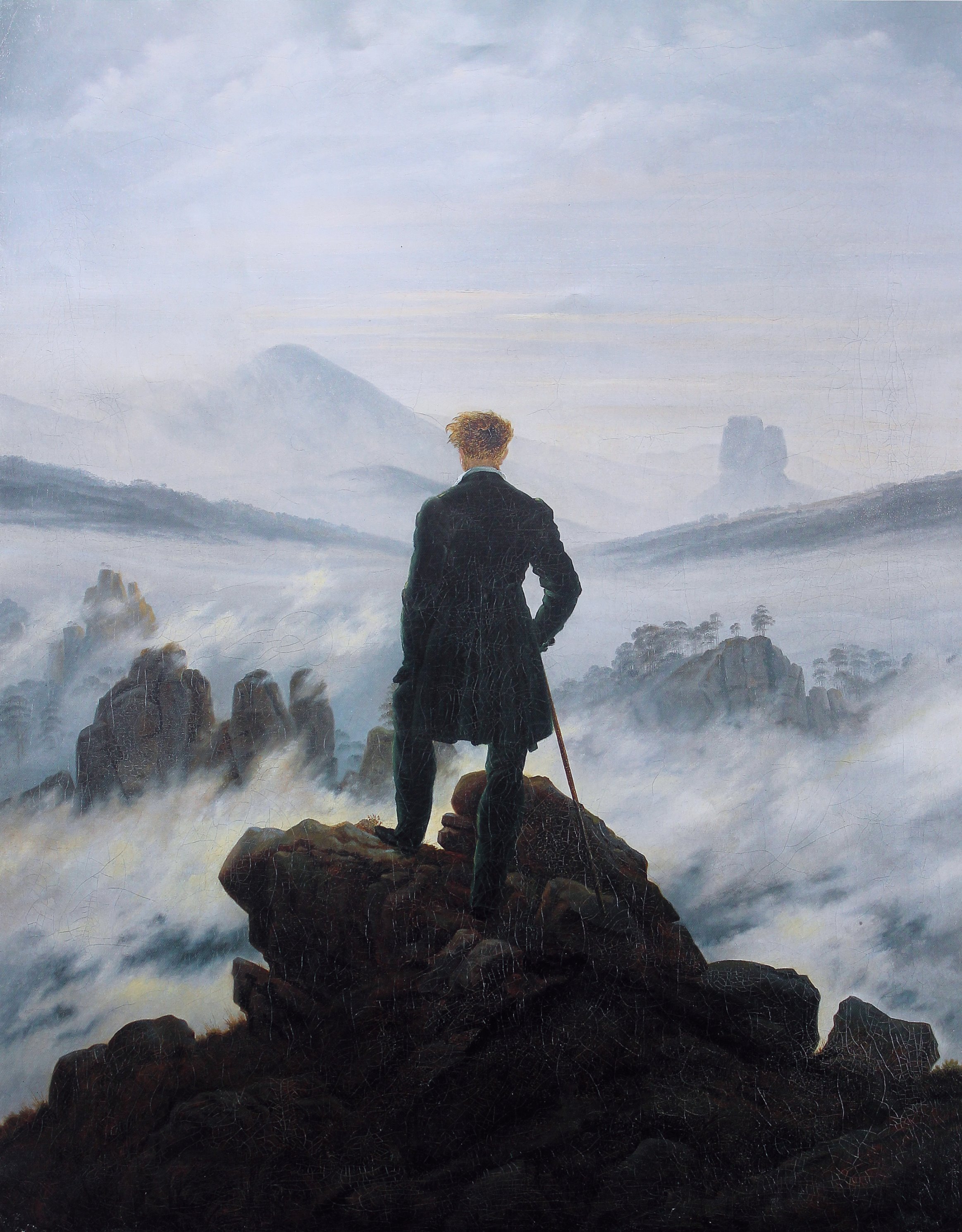
In Wanderer Above the Sea of Fog, Caspar David Friedrich shows a man with his back turned observing a mountainous landscape almost engulfed in mist. This choice seems simple, but it completely modifies the viewer's relationship to the painting: impossible to read the figure's face, one must literally take his place before the void.
Painted around 1818, Wanderer Above the Sea of Fog has become one of the emblematic images of German Romanticism. The main figure stands on a rocky summit, turned toward a landscape drowned in fog where a few mountain peaks emerge. Friedrich uses here a device frequent in his painting: the Rückenfigur, literally the "figure seen from behind."
This choice prevents direct psychological identification through the face. The viewer is invited to mentally occupy the figure's position rather than simply observe him. The romantic landscape then becomes an interior experience as much as a natural setting. The sea of clouds also plays an important role. It partially masks the world and transforms the mountain into a space of almost metaphysical contemplation.
At that time, several romantic thinkers were interested in the sublime: that sensation mixing fascination, vertigo, and transcendence in the face of something immense. The painting does not merely represent nature; it shows a consciousness confronted with a scale that exceeds it. The Wanderer remains fascinating because it transforms a simple motionless figure into an interface between human gaze and landscape immensity.