Art
The Forbidden Gaze
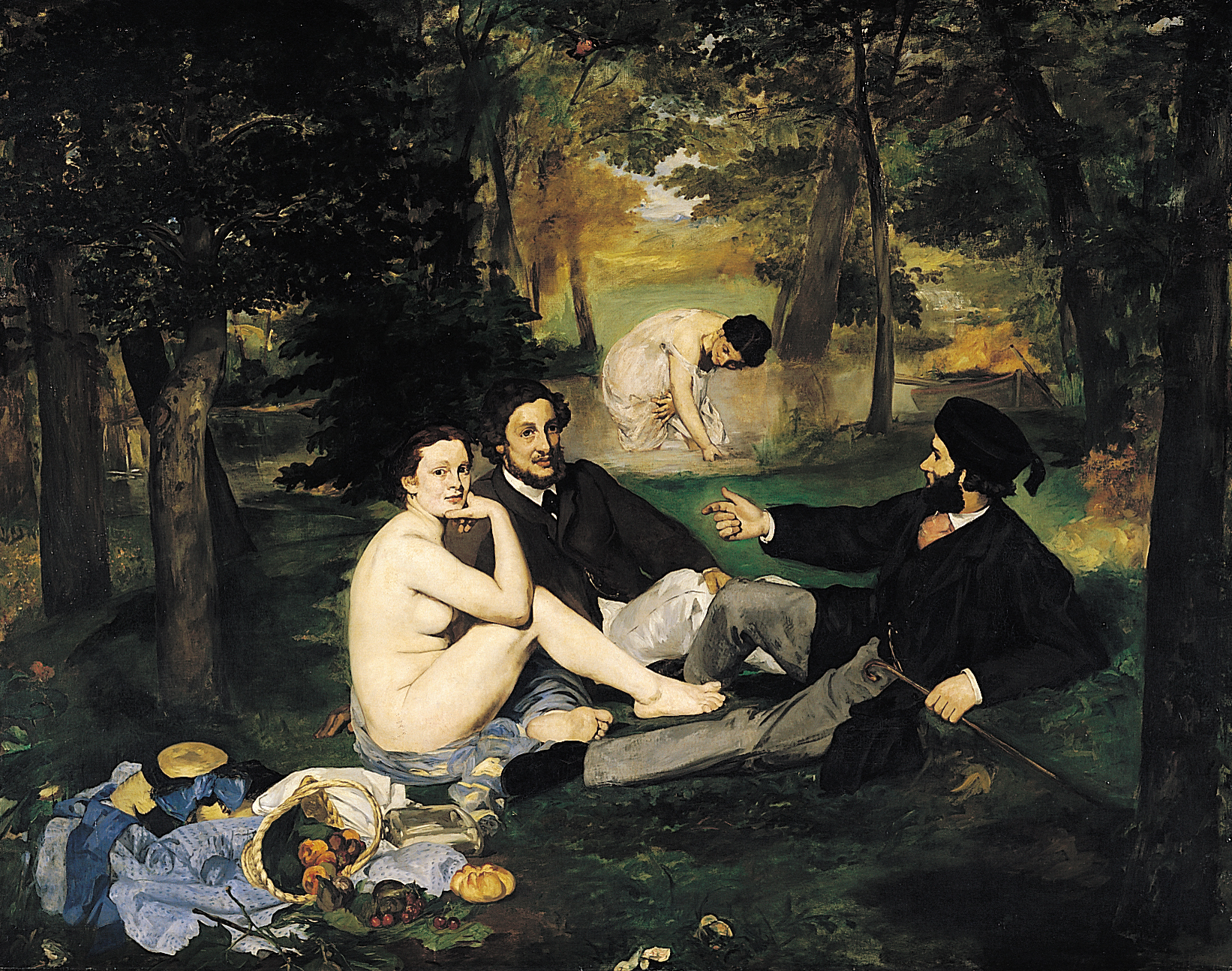
The scandal of Luncheon on the Grass comes not only from the nudity. The woman in the foreground looks directly at the viewer with an almost casual calm while the dressed men seem to ignore her. Manet thus destroys the usual codes of the academic nude: the scene appears contemporary, self-aware, and impossible to justify by a mythological pretext.
When Manet exhibited Luncheon on the Grass at the Salon des Refusés of 1863, the painting immediately triggered mockery and indignation. The public recognized motifs borrowed from classical Italian painting, but transposed into a present that makes them incongruous: two men dressed as contemporary bourgeois chat in a grove while a naked woman, seated near them, shows no embarrassment.
The scandal lies above all in her gaze. Where the academic nude averted its eyes or draped itself in a mythological pretext, she calmly fixes the spectator, fully conscious of being seen, and this frontality makes the one who looks an unwilling participant. Manet reinforces the trouble through his facture: abrupt contrasts, assumed flat areas, unstable proportions, up to that bather in the background who appears too large for the landscape.
This is where the work's modernity is played out, at the moment when painting ceases to conceal its artifices behind a harmonious illusion. Luncheon on the Grass disturbs therefore less because it shows a naked body than because it suddenly brings to light the social and visual conventions that were no longer noticed.