Literature
The Exploded Poem
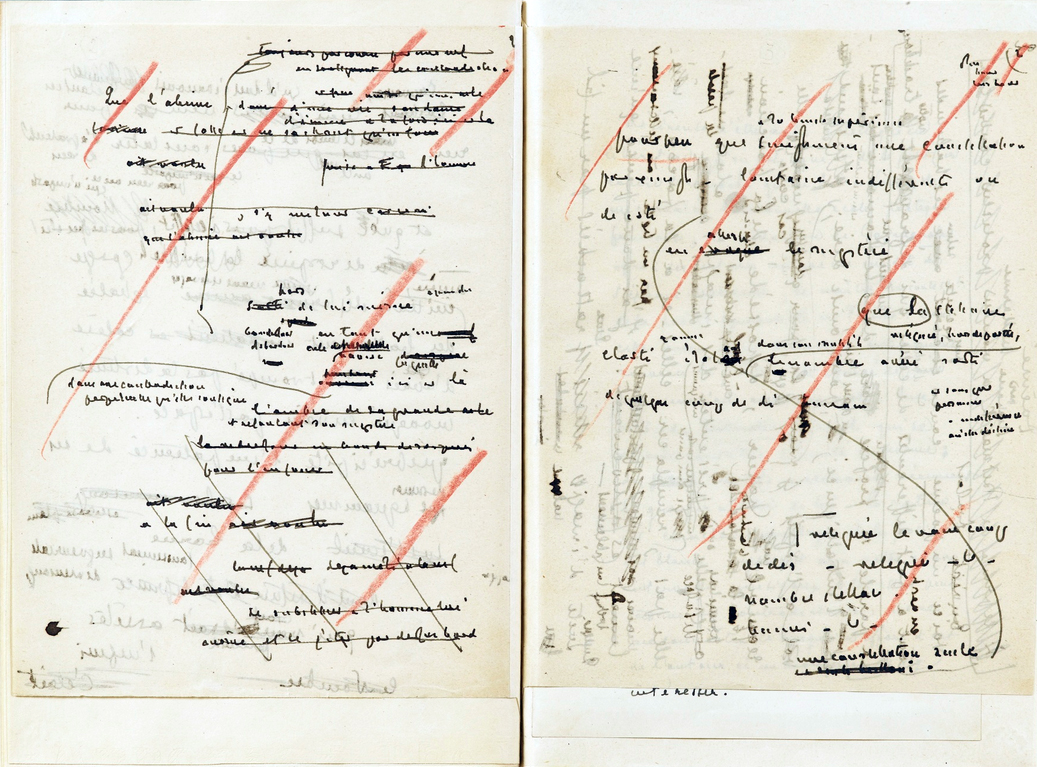
When Stéphane Mallarmé publishes A Throw of the Dice Will Never Abolish Chance in 1897, several readers almost think of a printing error. Words are scattered in void, some phrases explode in capitals while others disappear into margins. Mallarmé then transforms the entire page into visual space, as if poetry should also be read with eyes before even being understood by language.
At the end of the 19th century, French poetry remains still largely dominated by very regular visual structures: aligned stanzas, stable metrics, and compact text arrangement. With A Throw of the Dice Will Never Abolish Chance, Mallarmé brutally breaks this logic. The poem is published in 1897 in Cosmopolis magazine. Words are distributed across large double pages traversed by immense blanks. Some phrases surge in capitals, others appear tiny or isolated in a corner.
Mallarmé himself specifies that the page should be thought of as an entire unit and not as a simple linear succession of verses. Void then becomes as important as words. This layout produces a particular physical reading. The eye jumps, slows, hesitates, or anticipates fragments even before the complete sentence. The poem also contains several superimposed narrative lines that can almost be read separately.
Mallarmé wanted to create a form where typography, rhythm, and thought would function together as a visual score. The work then enormously influences 20th-century avant-gardes: Futurism, Dada, concrete poetry, and artist's books. Decades later, Marcel Broodthaers will go so far as to replace all the poem's words with black bands to reveal only its graphic structure.