Architecture
Angkor Wat, Temple-Mountain
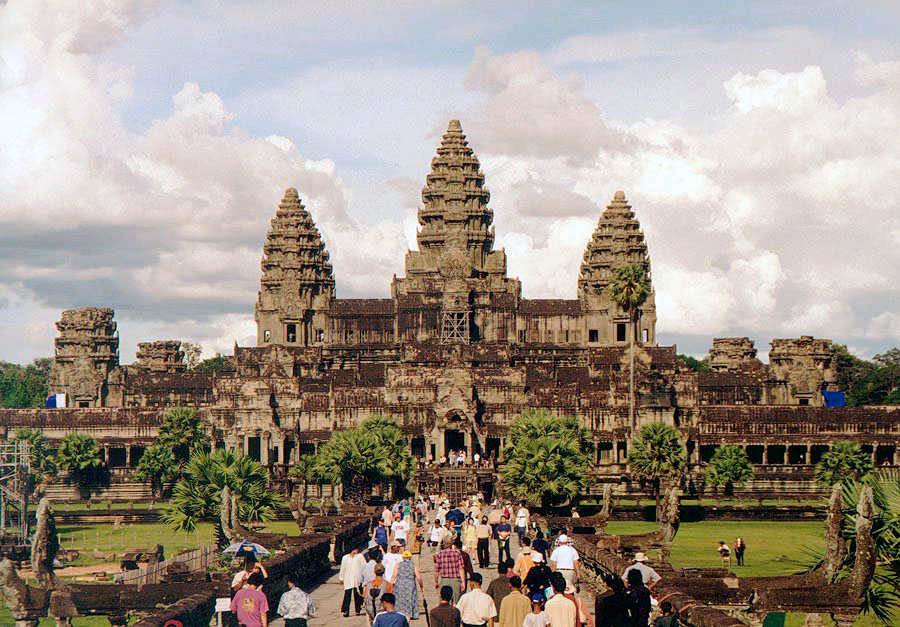
Angkor Wat, built in the twelfth century under Suryavarman II, is the world's vastest religious monument: a sandstone temple-mountain dedicated first to Vishnu, then converted to Buddhism. Its galleries unroll nearly a thousand meters of bas-reliefs, including the famous "Churning of the Ocean of Milk" where gods and demons pull the serpent Vasuki to extract the elixir of immortality. The central tower, sixty-five meters high, represents Mount Meru, axis of the Hindu cosmos. Gradually abandoned after the fifteenth century, the complex is retaken by jungle until French explorer Henri Mouhot makes its existence known in the West in 1860 — awakening of a Khmer city the vegetation had almost erased.
Suryavarman II reigns over the Khmer empire at its apogee, uniting territories corresponding today to Cambodia, part of Thailand, Laos and Vietnam. Angkor Wat, whose name means "temple of the capital," is conceived as dynastic mausoleum and legitimation instrument: the king identifies with Vishnu incarnate, guarantor of cosmic order.
The plan combines rectangular enclosure, symbolic moats and three levels of ascending terraces. The first floor's galleries preserve scenes from the Ramayana, the king's life and Khmer naval battles. The precision of sculptures, executed directly in sandstone, testifies to workshops organized over several decades.
After Suryavarman's death, the site continues to be maintained, then the Khmer power center shifts. Angkor Wat becomes Buddhist monastery; layers of murals are added to Hindu reliefs. The forest reclaims courtyards, kapok roots pry apart stone blocks.
Henri Mouhot, naturalist and traveler, publishes his sketches and accounts in 1863, a year after his death in Laos. He's not the first European to see Angkor, but his texts trigger French colonial enthusiasm for the site's conservation. Angkor Wat now appears on Cambodia's flag — rare honor for a monument become national symbol.