Art
The Vanished Yellow
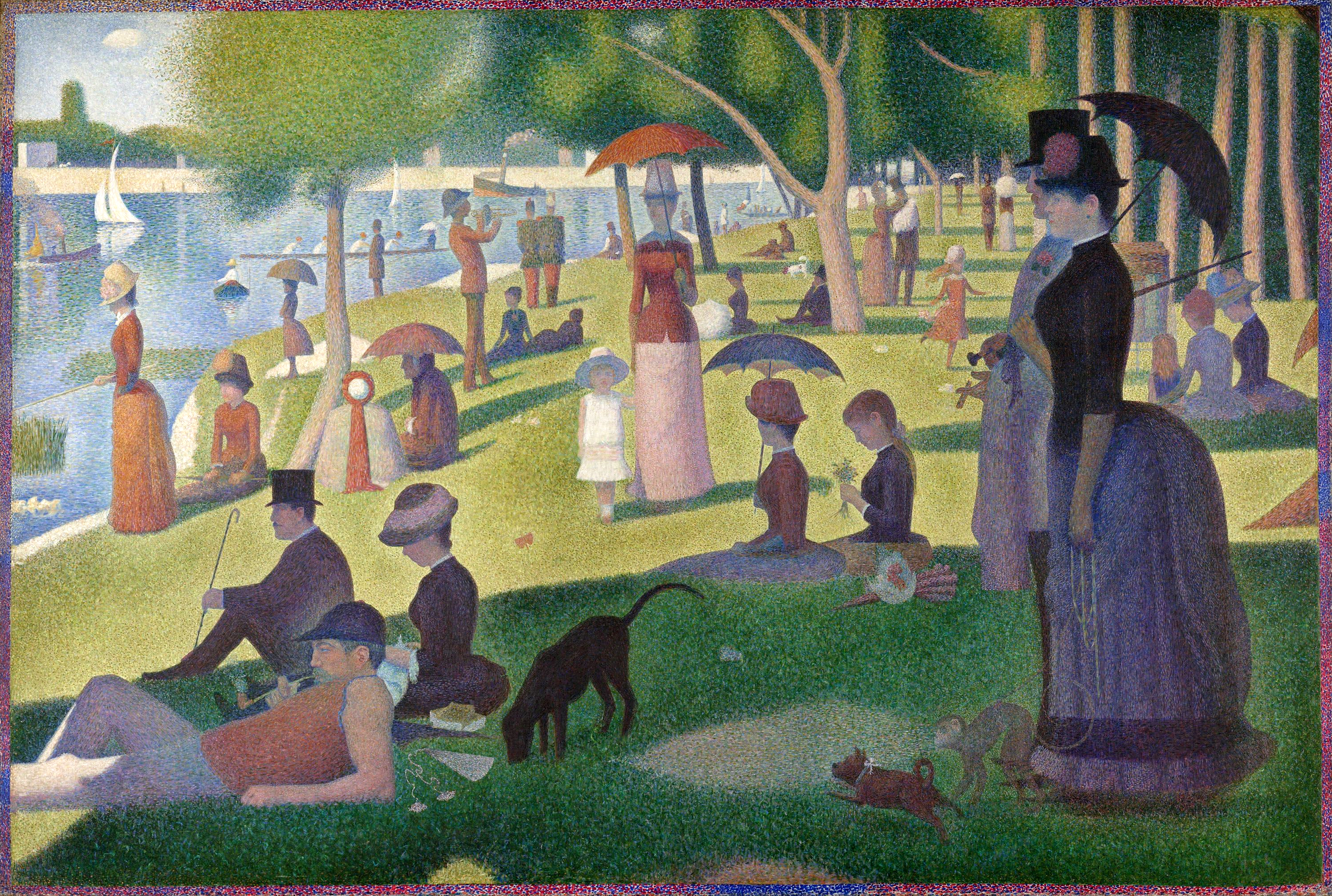
When you look at Seurat's La Grande Jatte today, you're probably not seeing the painting's true colors. Certain yellow pigments used by the painter have slowly browned over time. Scientists even think some areas were once much brighter and sunnier. The work visible in the museum is therefore slightly different from the one exhibited in 1886.
When Georges Seurat presented A Sunday Afternoon on the Island of La Grande Jatte in 1886, the scene appeared peaceful—elegant strollers, parasols, a few dogs, the Seine in the background—but as you approach, the silhouettes dissolve into thousands of small juxtaposed colored touches. Seurat belonged to a generation fascinated by science, in an era when theories of light and color perception captivated painters and physicists alike. Rather than mixing his shades on the palette, he placed pure dots side by side and let the viewer's eye recompose the image: this is pointillism, and the very particular luminous vibration that results.
For his most intense yellows, Seurat used chrome yellow, a modern pigment then very fashionable but based on toxic and especially unstable lead chromate. Over time, certain yellow areas brown or lose their brightness under the effects of light and air, so much so that recent analyses estimate that parts of La Grande Jatte were significantly brighter originally: the grass, dresses, and certain reflections had warmer tones than those visible today. The painting hanging in the museum is therefore not quite the one discovered by visitors in 1886.
This slow metamorphosis fascinates conservators, who scrutinize pigments with scanners and chemical analysis to understand their evolution, even simulating the work's original appearance digitally. It also recalls Seurat's almost obsessive meticulousness, capable of spending hours on a few centimeters of canvas and even painting the frame itself with small colored dots, to extend the optical effect into the borders.